How a Colorado Supreme Court ruling is reshaping the state's municipal courts
Published in News & Features
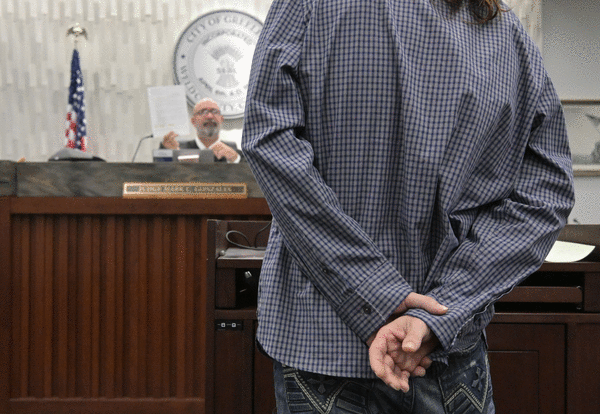
DENVER — Across Colorado, in bustling municipal courtrooms and council chambers, in city attorneys’ offices and public defender headquarters, legal professionals and elected officials are scrambling to make sense of a new normal.
The world of city courts was upended in late December, when the Colorado Supreme Court unanimously ruled that municipalities cannot impose harsher punishments on lawbreakers than state statute would allow for the same offense.
The 34-page ruling sought to rectify a disparity between municipal punishments and the state’s new sentencing scheme that dramatically reduced penalties for low-level offenses. As a result of the state’s changes, municipal courts became Colorado’s most punitive forum for minor crimes.
Now, weeks after the court’s decision, cities are reexamining their local ordinances, judges are altering their courtroom advisements of defendants, and defense attorneys and prosecutors are negotiating plea agreements in an entirely different landscape.
“These are uncharted waters,” said Colette Tvedt, Denver’s chief municipal public defender.
Her office on Monday gave a presentation to the Denver City Council, outlining the implications of the state Supreme Court’s ruling while expressing urgency that the legislative body act quickly to bring the city’s code into compliance.
“Without council action, applying this rule to our sentencing ordinances will lead to endless litigation, confusion and additional violations of Denverites’ constitutional rights,” the public defender’s office wrote in its presentation.
Until Denver’s code is amended, Tvedt’s office argued, there are legal questions about whether the city’s criminal laws are enforceable because the sentences for many offenses are unclear. There is also a risk that defendants will receive illegal sentences because municipal court judges might come to conclusions that higher courts later overturn, the public defenders said, warning that the entire process could represent a “huge expense and uncertainty for years to come.”
Councilmembers, for their part, have expressed their desire to change the city’s code so it aligns with state penalties. The question will be determining which offenses have comparable state counterparts.
Sarah Parady, one of the councilwomen spearheading the changes, said she hoped to have language outlining proposed alterations by the end of the month.
“This is cuckoo bananas if we don’t do our job,” she said.
Other cities are also taking action.
The Littleton City Council on Jan. 6 passed an emergency ordinance amending its general penalty provision in order to “comply with state law and to avoid confusion.” The updated language states that penalties for non-felony criminal violations where the prohibited conduct is identical to a corresponding state charge will be capped at the state law’s maximum sentence.
Reid Betzing, the city attorney, acknowledged during the council meeting that the city is aware of what it needs to do to comply with the Supreme Court’s decision, but that it upends 120 years of home-rule doctrine in Colorado.
“We’re not necessarily super excited about it,” he said.
The city councils in Westminster and Aurora on Monday held executive sessions with their attorneys to review the Supreme Court decision and how it impacts their cities’ codes.
“Obviously, this decision bolsters the need to look at our sentencing practices,” Alison Coombs, an Aurora councilmember, said in an interview.
Kevin Bommer, executive director of the Colorado Municipal League, said his organization was “exceptionally disappointed” in the ruling, adding that it will mean “a complete revisiting of what we thought municipal courts were constitutionally allowed to do.”
There are broader implications, he said. “It’s not a threat, it’s just facts: If municipal courts are essentially de facto arms of the state, why on earth would municipalities go through the time and expense of going through those cases?”
‘This will make our jobs a lot easier’
Local judges, prosecutors and defense attorneys, meanwhile, are already seeing the decision’s impact in municipal courtrooms around the state.
Aurora Municipal Court Judge Brian Whitney issued an order last year pausing more than 300 cases in which attorneys challenged issues under the same pretenses as those before the Supreme Court. This month, Whitney ordered that those cases can now move forward, but must adhere to the new guidelines set by the high court.
“Any sentence imposed… must not exceed the applicable state statutory maximum for the corresponding identical offense,” he wrote in a Jan. 2 order.
Arvada Municipal Court Presiding Judge Kathryn Kurtz said the ruling doesn’t change too much in her courtroom, since she already generally stuck to state guidelines. There will be some small, technical updates, such as changing the advisement sheet that informs defendants about possible penalties for their infractions.
“It’s good to have finality on it,” she said in an interview. “We now know this is the law and we can move forward. Judges work very well with rules. When you give us clarity, it provides guidance. When there’s gray, that gives us issues. This will make our jobs a lot easier.”
Defense attorneys say they anticipate the ruling will also have a significant impact on plea negotiations with their clients.
Consider Denver’s municipal code: Retail theft or trespassing are each punishable by up to 300 days in jail. In state court, those offenses carry up to 10 days in jail. In Aurora, those same offenses could mean up to 364 days in jail — more than 36 times the potential sentence in state court.
If a defendant in Denver faced 300 days in jail and had multiple prior convictions, plea negotiations might start with 30 days and go up to 120 days, said Tvedt, the Denver municipal defender chief. But if the maximum penalty for a minor offense is just 10 days, their client might take a plea that would involve just a couple of days behind bars.
Individuals might also be more willing to take their cases to trial, knowing that they don’t risk up to a year in jail, defense attorneys said.
“This is really gonna be transformative to municipal courts,” Tvedt said.
‘Effects of this are wide and varied’
Then there’s the question of what to do with people who have been sentenced since March 1, 2022, when the new state guidelines took effect. Multiple attorneys said they believed anyone with a sentence that conflicts with the Supreme Court ruling has a legal argument that it should be negated.
“Right now, the priority has to be on individuals already sentenced and still serving illegal sentences,” said Elizabeth Cadiz, Aurora’s chief public defender.
There’s still plenty of confusion surrounding the new rules.
In Denver’s municipal court last week, a judge advised a defendant charged with trespassing that they faced up to 300 days in jail — an offense that would only involve up to 10 days in jail under the state guidelines.
Those involved in municipal court operations say it will take time to figure everything out, but the wheels are in motion all over the state.
“Most of us, our heads are spinning,” Cadiz said. “The effects of this are wide and varied.”
-------------
©2026 MediaNews Group, Inc. Visit at denverpost.com. Distributed by Tribune Content Agency, LLC.






Comments