Analysis: Million-plus immigration-benefits applications from Cuba, Haiti, Venezuela frozen
Published in News & Features
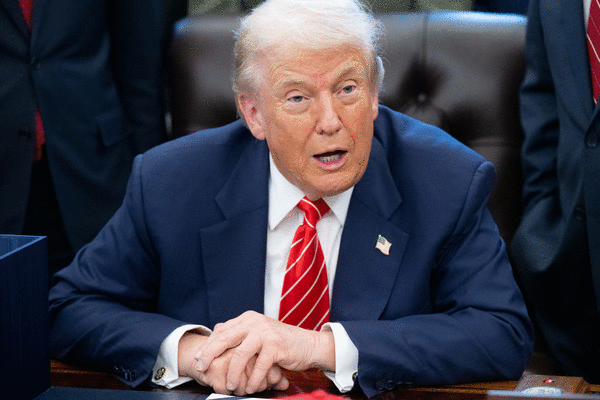
The Trump administration’s profusion of travel bans and visa-processing freezes has had the largest impact on Cubans, Haitians, and Venezuelans seeking to legally emigrate to the United States, according to a new analysis from a Washington think tank.
A Cato Institute report published Wednesday estimates there are over 1.2 million frozen immigration-benefits applications from these three countries, out of 2 million frozen in total across all countries. That breaks down to 935,000 applications from Cubans, 239,000 applications from Venezuelans and 81,000 from Haiti.
“The majority of applications and fees are coming from those three nationalities,” David Bier, the institute’s Director of Immigration Studies and author of the analysis, told the Miami Herald on Wednesday. The Cato data analysis looks at freezes on work authorization, family-based and employment-based green cards, asylum applications, and naturalization petitions, work and tourism visas, among other immigration benefits.
According to Cato, there are 157,000-plus Cubans currently in the United States trying to get green cards with applications on pause through a process known as adjustment of status. Nearly all are cases filed through the Cuban Adjustment Act, a decades-old law that lets Cubans in the U.S. apply for permanent residency a year and a day after their arrival in the U.S.
Cuba also had the largest number of naturalization applications on hold, 35,870, followed by Haiti, at 14,560, according to Cato. Haiti also had 6,750 adjustment of status applications, while Venezuela had 16,870 adjustment of status and 10,780 naturalization applications on hold, the analysis estimated.
Cato’s detailed analysis sheds light on how President Donald Trump’s travel bans and visa processing pauses are affecting South Florida, home to the largest communities of Cubans, Haitians and Venezuelans in the United States.
There are over 1 million naturalized or native-born Americans of Cuban, Venezuela, and Haitian descent in Miami-Dade and Broward counties, according to a Herald tally of U.S. Census Bureau estimates. Many of them have sponsored spouses and family members, whether in the United States or abroad, for their immigration visas, or have relatives left in limbo by the Trump freezes. Those numbers also don’t include U.S. permanent residents from those countries who can also apply for green cards for relatives.
In all, 34% of the total applications on hold are from people applying for green cards, immigrant visas, or citizenship, according to the Cato analysis, and roughly half are for work authorization permits.
The total applications add up to about $1 billion in application fees, according to Bier. That includes in $543 million in applications from Cubans, $138 million from Venezuelans and $56 million from Haitians, according to the analysis. Bier wrote that the federal government’s decision to accept without processing the applications is “the largest fraud in history of the U.S. immigration system.”
The Cato Institute’s research examined three Trump administration policies in combination. The layering of seemingly redundant policies targeting the same countries — new visa charges, entry bans and benefit-application freezes — are designed to create so many bureaucratic hurdles that people give up, experts and lawyers have told the Herald.
“It is virtually impossible to get through all of these, especially if you are starting the process now, and if not, if you are trying to sponsor a spouse, you need to make it through three different bans to make it to the finish line,” Bier said. “It really is a hopeless situation.”
During its first year in office, the Trump administration took several steps to curb legal immigration. Trump issued presidential proclamations in June and December banning people from 40 countries from entering the United States or receiving most visas, with extremely narrow exceptions. Most of the banned countries are in Africa, but also include Cuba, Venezuela, Haiti, Antigua & Barbuda, and Dominica.
U.S. Citizenship and Immigration Services has halted processing of immigration benefits such as asylum, citizenship, green cards, and work authorization from countries subject to the presidential proclamation. The agency — which processes applications for people already here and a limited number abroad — also ordered a review on all applications that had been approved under the Biden administration.
Separately, the State Department stopped issuing all immigrant visas to 75 countries as of Jan. 21, saying it was because their nationals took welfare from the U.S. at “unacceptable rates.” The State Department processes visas through its consulates and embassies all over the world.
Another recent study from the CATO Institute found that between 1993 and 2023, immigrants had generated more in taxes than the average person or what they cost the government in benefits. It also concluded that over those three decades, immigrants had generated $14.5 trillion in fiscal surplus for the government.
Along with its pause on visa processing, the State Department slapped “visa bond” charges ranging between $5,000 and $15,000 to several countries, also including Cuba and Venezuela, to people traveling to the U.S. for tourism and business. On Wednesday, it expanded the visa bond program to 50 countries, including new ones such as Nicaragua and Grenada.
To arrive at these numbers, Bier said he had to do “a lot of digging.” The Cato team had to figure out from where and who the applications were coming, as well as rely on some indirect estimates. Application fees vary depending on the type of applicant, whether someone is an adult or a dependent, and whether they pay certain processing fees.
©2026 Miami Herald. Visit at miamiherald.com. Distributed by Tribune Content Agency, LLC.






Comments