Merz plans Trump call while doubling down on MAGA criticism
Published in News & Features
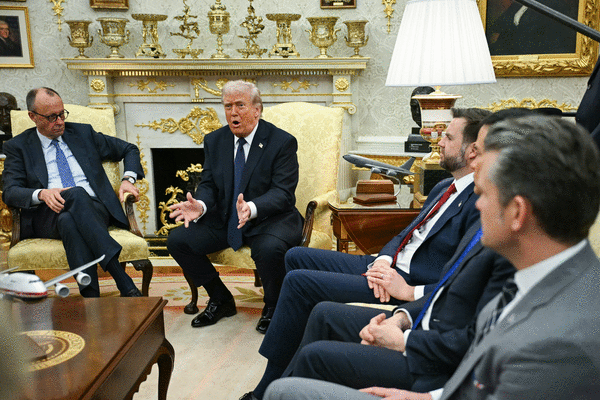
German Chancellor Friedrich Merz has once again distanced himself from Donald Trump’s political base, while indicating he plans to continue engaging with the U.S. president.
“The MAGA movement is not our movement,” he said at an election event in Bad Dürkheim in Rhineland-Palatinate last night. “And the way they treat culture and the media, the way they interact with one another, is not our idea of democracy. We have a different vision.”
Merz added that he intends to call Trump over the weekend to discuss the war in the Middle East, the unfolding energy crisis and an invitation for a state visit of the U.S. president to Germany in September.
The chancellor had repeatedly drawn a line between his government and Trump-style politics, saying at the Munich Security Conference in February that the “culture wars of the MAGA movement are not our own.” Ties between the NATO allies have come under strain over disagreements on issues ranging from trade to the U.S.-Israeli war on Iran, which has driven a surge in oil and gas prices.
Merz faces another test on Sunday when the western German state of Rhineland-Palatinate goes to the polls, the second of five regional ballots this year. Polls show a tightening race in Rhineland-Palatine, with the Christian Democratic Union’s once-solid lead over the SPD shrinking as the ballot draws nearer. Merz’s conservatives had 29% support, two percentage points ahead of the SPD, according to a March 19 poll for ZDF.
A similar dynamic played out two weeks ago in Baden-Wuerttemberg, where Merz’s party saw a double-digit lead over the Greens evaporate in the weeks before the contest. The environmental party won by less than a percentage point, extending its 15-year stewardship of the state, home to Mercedes-Benz AG and Porsche AG.
Merz said he plans to invite Trump, whose grandfather emigrated from Germany to the U.S. in 1885, to Bad Dürkheim in September. Still, it’s unclear whether Trump will accept the invitation.
“He’s not exactly on good terms with me at the moment,” Merz said, adding that the transatlantic partnership is currently undergoing a fundamental transformation.
“It may be that we no longer have the Americans on our side without any reservations,” the chancellor said. But he added that he didn’t want to abandon the transatlantic bond that had grown over many decades. “I will fight to ensure that it is preserved.”
(Arne Delfs contributed to this report.)
©2026 Bloomberg L.P. Visit bloomberg.com. Distributed by Tribune Content Agency, LLC.






Comments