NC, SC attorneys general ask Trump to help stop fentanyl money laundering on apps
Published in News & Features
CHARLOTTE, N.C. — The attorney generals of North Carolina and South Carolina are calling on President Donald Trump to help crack down on fentanyl-related money laundering through encrypted chat apps.
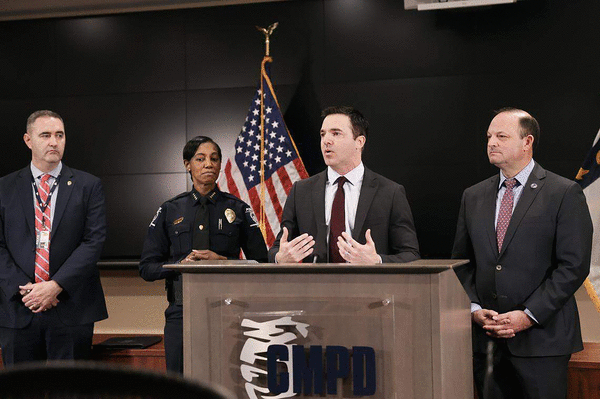
N.C. Attorney General Jeff Jackson spoke at a news conference Monday morning alongside South Carolina Attorney General Alan Wilson and Charlotte Police Chief Estella Patterson at the Charlotte-Mecklenburg Police Department headquarters in uptown.
“A huge part of the fentanyl epidemic is propped up with money laundering. We estimate that it is to the tune of about $100 million a week,” Jackson said. “We looked at where this money was flowing, and the evidence was pretty clear that one of the main places where fentanyl money laundering was occurring was in an app called WeChat.”
WeChat is an encrypted messaging app owed by a Chinese company called Tencent. A bipartisan coalition of attorneys general previously convinced WeChat to cooperate with law enforcement, which Jackson said made the platform more hostile to fentanyl money laundering.
But the version of WeChat used in mainland China, known as Weixin, is less cooperative, Jackson said. It is not subject to U.S. jurisdiction.
“We are asking the president and the federal government to make this a national security priority,” Jackson said. “The president has already spoken at length about his belief in tackling fentanyl, and has taken really positive steps in that direction ... We believe this deserves to be among those steps of all the things the president is negotiating with China.”
Comes from Mexico and China
Most fentanyl in North and South Carolina comes from Mexican drug cartels, made in collaboration with the Chinese, Wilson said. The U.S. Government Accountability Office said in 2025 that most fentanyl, as well as the chemicals and equipment used to make the narcotic, comes from Mexico or China.
In 2024, when Gov. Josh Stein was N.C. attorney general, he and former CMPD Chief Johnny Jennings said it was essential to stop fentanyl at the U.S.-Mexico border.
Wilson said 72% of overdose deaths in South Carolina in 2023 were related to fentanyl. CMPD Deputy Chief Ryan Butler, who also spoke at the news conference, said 80% of overdose deaths in Mecklenburg County in 2025 were fentanyl-related.
Patterson said CMPD was looking at how apps like WeChat are being used to facilitate drug operations and money laundering in Charlotte and “closing the digital door.”
Wilson said the fentanyl crisis is a public safety and public health crisis, and that a letter has been sent to the Trump administration asking for help. The problem is beyond the scope of law enforcement and requires intervention from a diplomatic level, Wilson said.
_____
©2026 The Charlotte Observer. Visit charlotteobserver.com. Distributed by Tribune Content Agency, LLC.






Comments