St. Paul anti-Trump rally draws tens of thousands, Springsteen; Bernie Sanders, Rep. Omar appear
Published in News & Features
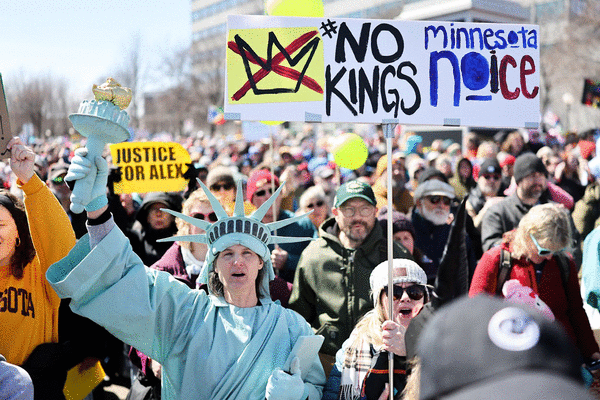
ST. PAUL, Minn. — Tens of thousands of demonstrators gathered at the Minnesota state Capitol in St. Paul on Saturday for a rally serving as the “national flagship” for a third round of nationwide protests against what participants call the authoritarian aims of President Donald Trump.
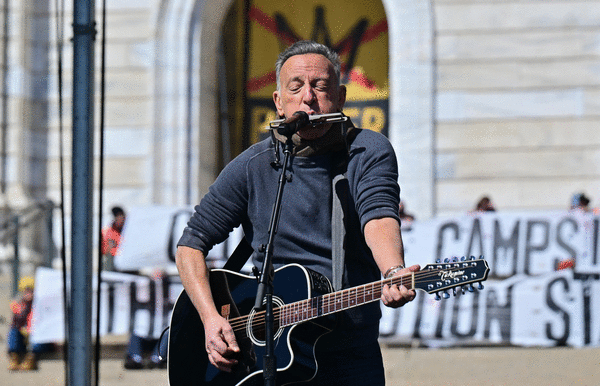
The “No Kings” rally headlined by singer Bruce Springsteen was one of more than 3,000 taking place across the U.S. on Saturday, with millions expected to participate. Folk singer and activist Joan Baez, actress Jane Fonda and Vermont Sen. Bernie Sanders also appeared in St. Paul.
After the thousands converged on the Capitol grounds from three separate marches across the city, Gov. Tim Walz introduced Springsteen, who performed “Streets of Minneapolis,” a protest song against the Trump administration’s immigration crackdown in the Twin Cities.
The song was dedicated to city residents, immigrants and Renee Good and Alex Pretti, both U.S.-born citizens who were fatally shot in Minneapolis in January by federal immigration agents. For nearly two months this winter, the Twin Cities were the epicenter of the Trump administration’s national and often violent immigration policies, and of local pushback to those policies. Both sides were well-documented nationally on social and mainstream media.
“Here in our home, they killed and roamed, in the winter of ’26. We’ll remember the names, of those who died, on the streets of Minneapolis,” Springsteen sang.
In a speech, Sanders praised the Twin Cities for resisting the Trump administration and setting a national example for grassroots activism.
“It is absolutely appropriate that we hold a major ‘No Kings’ rally right here in the St. Paul-Minneapolis area. When historians write about this dangerous moment in American history, when they write about courage and sacrifice, the people of Minnesota will deserve a special chapter for themselves,” he said. “In the face of unprecedented occupation of this city by ICE, Trump’s domestic army, this community stood up and, with extraordinary solidarity, fought back and won.”
Democratic Minneapolis U.S. Rep. Ilhan Omar described the Trump administration’s actions as a “full-scale assault on our rights, our institutions and the rule of law.”
“I could have never imagined the day would come when we were staring down at this kind of creeping authoritarianism in the United States of America,” she said.
The St. Paul rally and third round of national protests come in the wake of the Trump administration’s immigration crackdown, during which thousands of U.S. Immigration and Customs Enforcement and Border Patrol agents were sent to Minnesota, and thousands of people were detained and deported.
The massive expansion of enforcement operations drew local resistance from activists, leading to clashes with federal agents and the deaths of residents Good and Pretti during confrontations with ICE and Border Patrol. The crackdown also caused widespread fear among those in immigrant communities, regardless of whether they are citizens or otherwise legally in the U.S., concerned about racial profiling and arrest by agents.
Some demonstrators said they had personally experienced the negative effects of the immigration operation in Minnesota. Brandon Dominguez, a special-education paraprofessional from St. Anthony, said Operation Metro Surge directly affected his work in school as students stayed home in fear of federal immigration raids.
“My daughter was worried about us, because my father’s family comes from Mexico,” said Dominguez, 37. “It really brought it all home to have the dwindling attendance at her bus stop, and have her come to us crying and emotional about being in danger, and just recognizing that that’s not the way that we should be living in our country.”
Savannah Roher, a 26-year-old nurse from Rochester, Minnesota, who came to St. Paul for the Saturday rally, said that she was concerned about rising health care costs and that a significant number of patients stopped showing up at the clinic where she works when ICE came to her city.
“A lot of my patients are struggling. We do a walk-in clinic, so we see a lot of immigrant patients, we see a lot of patients without insurance, and prices are getting so bad that my patients aren’t getting health care, and then when they come in, they’re incredibly sick,” Roher said. “It’s not safe, particularly for immigrants.”
Others like Sarah Marchand, 63, of St. Paul, said they were worried Trump would try to hold on to power after his second term ends — even though he is constitutionally forbidden from doing so. Trump has expressed interest in continuing to serve and has not definitively ruled out a third term, though he has acknowledged he’s not allowed to run again.
“It’s not just a president I don’t agree with; I’ve had plenty of those,” Marchand said. “He was fairly elected, and I agree with democracy, (but) it’s that he wants to stay there, and that’s what ‘No Kings’ is about.”
In an unrelated Friday interview, Minnesota Senate Minority Leader Mark Johnson, R-East Grand Forks, described the upcoming “No Kings” rally as “hypocrisy,” characterizing the Republican Trump administration’s immigration crackdown as enforcing existing federal law, albeit with “some missteps,” and Minnesota’s Democratic governor’s pandemic policy as “dictatorial” overreach.
“You come to a state like Minnesota, where you have a governor who locked down the schools, locked down the businesses, had a tip line to allow people to tattle on their neighbors and friends if they weren’t following the COVID protocols,” Johnson said. “Then you have a rally against a president who’s for all intents and purposes following federal law. To me, it’s just crazy.”
Thousands of “No Kings” events took place across the U.S. during the first round last June, with organizers claiming millions in attendance.
Tens of thousands of people attended the first protest at the Minnesota Capitol on June 14, the same day of the assassination of former Minnesota House Speaker Rep. Melissa Hortman and her husband, Mark, and the shootings of state Sen. John Hoffman and his wife, Yvette.
The Minnesota State Patrol said about 25,000 people attended that rally, while organizers claimed 80,000. That turnout came even though dozens of “No Kings” events were canceled in the state amid an ongoing manhunt for the man suspected of the shootings.
A subsequent rally near U.S. Bank Stadium in downtown Minneapolis last October saw 100,000 attend, according to organizers. The exact number who attended Saturday’s rally wasn’t immediately clear, but organizers said they believed it would be the “largest yet.” The crowd appeared much larger than the June rally, though the State Patrol did not have an attendance estimate as of Saturday afternoon.
©2026 MediaNews Group, Inc. Visit at twincities.com. Distributed by Tribune Content Agency, LLC.



Comments