Gov. Wes Moore set to sign fast-tracked Maryland budget Wednesday
Published in News & Features
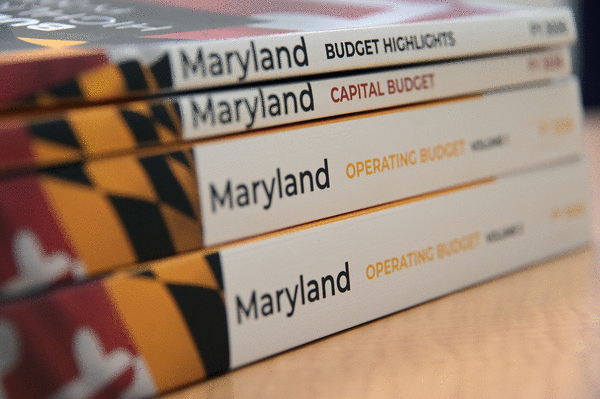
BALTIMORE — Gov. Wes Moore is expected to sign the state budget into law on Wednesday, multiple sources told The Baltimore Sun, finalizing just over two months of negotiations among Maryland lawmakers as they sought to close a billion-dollar deficit without raising taxes.
House Speaker Joseline Peña-Melnyk’s office is expecting the governor to sign the budget this week. This is the fastest the budget has moved through the General Assembly since 2020, when lawmakers shortened their legislative session due to the COVID-19 pandemic. Although Moore is expected to sign the amended version of his budget proposal into law, he could potentially veto parts of the budget he disagrees with. Neither Moore nor his office has commented on the final version.
The governor in January proposed a $70.8 billion fiscal 2027 budget that makes billions of dollars in cuts to several state programs while averting tax increases to address a projected $1.4 billion deficit. The final version of the budget, amended by the Maryland House of Delegates and Senate, largely restores the governor’s proposed cuts as well as leaves over $250 million in surplus and more than $2 billion in the state’s rainy day fund.
Moore’s signing of the budget follows through on earlier Democratic commitments, made ahead of the 2026 legislative session, to lower costs, including efforts to reduce what Marylanders pay for electricity. The state’s cost of living has partly contributed to a 4-point decline in his job approval rating in recent months: A recent poll conducted by the University of Maryland, Baltimore County found the governor’s popularity dropped from 52% to 48%, with many respondents citing concerns about rising grocery, energy and housing prices.
The budget the governor will sign features cuts to funding for disability care services and renewable energy projects, among other areas. But the budget also invests in some of Moore’s key priorities: public safety, education and housing.
Proposed cuts
Among the cuts Moore could sign off on is a nearly $127 million reduction from the Developmental Disabilities Administration (DDA) to curb long-term spending growth, a move that has drawn pushback from lawmakers and advocates who warned it could weaken lifesaving care for individuals living with disabilities.
While the DDA’s budget will increase overall, reductions will target wage caps for caregivers, the limit on family-paid care hours, and service provider rates. These changes affect both traditional provider-run programs and self-directed care, where individuals can manage their own services, raising concerns about staff retention, service availability, and long-term stability.
House Minority Leader Del. Jason Buckel told The Sun that the debate over DDA funding highlighted tension between how to fully support vulnerable residents and the fiscal and structural constraints that made some level of cost containment unavoidable.
“If left to me, I would choose to allocate these funds differently, but I can’t overly criticize legislative colleagues from the budget committees who delved deep into the issue and concluded that, this year, cost containment was necessary,” Buckel said. “I hope going forward the programs are sustained and adequate funding [is] found to care for these folks and their families in the best way possible.”
The state budget will also cut $292 million from the Strategic Energy Investment Fund, which pays for renewable energy projects and programs that decrease energy demand and increase supply.
To lower energy costs, however, Democratic leadership in March introduced comprehensive energy legislation — the Utility Relief Act — aimed at lowering electricity bills and boosting in-state energy generation, and tightening utility oversight, as residents face skyrocketing energy costs. This legislation will be funded by the remainder of the SEIF’s funds, and if passed, could lower electricity bills by at least $150 per year for the average Maryland household while also expanding assistance programs for low-income residents.
The Utility Relief Act also scales back Maryland’s flagship energy efficiency program, emPOWER Maryland. Energy advocates have cautioned that this could ultimately increase costs in the long term.
--------------
©2026 The Baltimore Sun. Visit at baltimoresun.com. Distributed by Tribune Content Agency, LLC.






Comments