Criminal Hope Florida probe appears to be wrapped, but IRS inquiry could soon begin
Published in News & Features
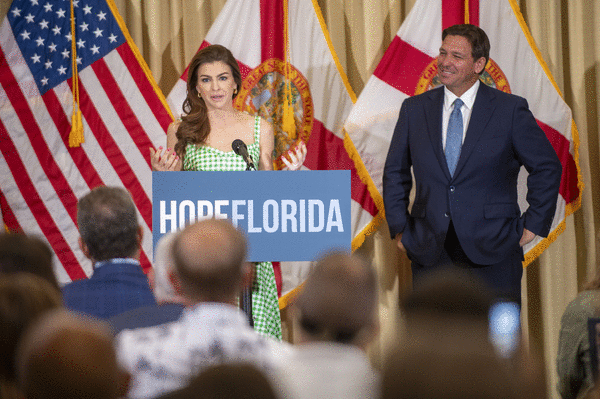
TALLAHASSEE, Fla. — A criminal probe into the Hope Florida Foundation is likely concluded, but the state-created charity could soon pique the interest of the Internal Revenue Service when it files its tax return.
The foundation’s financials, due May 15, should include the charity’s accounting for the $10 million it received from a state Medicaid settlement, most of which wound up in a political committee intent on defeating the recreational marijuana ballot amendment during the 2024 election — a priority for the governor.
Three nonprofit tax experts told the Tampa Bay Times/Miami Herald that the foundation’s spending could jeopardize its tax-exempt status by running afoul of laws that regulate how much charities can spend on lobbying or politics.
“I think the [Hope Florida Foundation] has a very, very big problem here,” said Eric Gorovitz, a nonprofit tax law attorney based in San Francisco.
It remains to be seen if President Donald Trump’s trimmed-back IRS will take interest in the Hope Florida Foundation’s finances. But If the charity loses its tax-exempt status, it will become difficult to operate. Not only will it have to pay taxes on donations, but donors will no longer be able to write off the giving on their own taxes, potentially undercutting revenues and harming the foundation’s purpose: to financially support a network of nonprofits and churches so they can provide services to needy Floridians in place of government aid. In addition, the organization could pay hefty back taxes as a penalty.
The charity addressed the possibility last week that its spending could pose an issue with the IRS. A draft financial report released at the quarterly Hope Florida Foundation board meeting states the charity “is not aware of any activities that would jeopardize its tax-exempt status.”
Foundation Attorney Jeff Aaron did not answer the Times/Herald’s questions about that statement. Neither did the Texas accounting firm, Atchley and Associates, which wrote the report.
The foundation’s board members on March 30 voted to approve the financial report without any discussion.
An IRS spokesperson said on April 2 that the agency couldn’t discuss the charity’s finances, citing federal privacy laws.
What an IRS auditor would look for
The IRS limits how much 501(c)(3)s like the Hope Florida Foundation can spend on lobbying, and it outright prohibits political spending. Money spent on a constitutional ballot initiative would be considered lobbying, and money spent on a candidate is political, the experts said.
Records indicate much of the $10 million went to both.
After the DeSantis administration steered the money to the Hope Florida Foundation, the charity wired $5 million to Secure Florida’s Future, run by the Florida Chamber of Commerce. It wired another $5 million to Save Our Society From Drugs, a St. Petersburg organization associated with Drug Free America.
The two nonprofits then sent $8.5 million to Keep Florida Clean, the political committee intent on defeating the recreational marijuana amendment. Attorney General James Uthmeier controlled Keep Florida Clean during the 2024 election to assist the DeSantis administration’s effort to defeat the recreational marijuana amendment. At the time, Uthmeier was Gov. Ron DeSantis’ chief of staff.
What happened to the remaining $1.5 million is unclear. On the same day that Secure Florida’s Future sent an initial $2 million to Uthmeier’s committee, it sent another $1 million across seven political action committees controlled by the Florida Chamber of Commerce. Those committees have given to the Republican Party of Florida and various Republican candidates, including Uthmeier, since then.
Keep Florida Clean doesn’t appear to have spent the money directly — it gave $7 million to the Republican Party of Florida, which was fighting the ballot initiatives and supporting GOP politicians across the state. After the election, Keep Florida Clean gave $1.1 million to the Florida Freedom Fund, DeSantis’ political committee.
“That’s the kind of fact pattern that shows that there was an intention to benefit one political organization, and not provide a sort of general public benefit,” said Marcus Owens, a former director of the Exempt Organizations Division of the Internal Revenue Service.
Uthmeier has justified the spending, saying that because the money went to fight the amendments — an “issue” — and not a political candidate, it was legal.
“I think the media misunderstands the difference between the issue committees and political candidate committees under IRS code,” Uthmeier said last April. “An issue committee can fight against a ballot initiative. And I’m very thankful those groups stepped up and helped us secure a big win.”
Last year, after spending nearly a month probing the charity’s expenditures through his House Health Care Budget Subcommittee, Republican state Rep. Alex Andrade urged the Hope Florida Foundation board during its first public meeting to recoup the $10 million from the two dark-money groups so as to not jeopardize its tax status.
Two board members who brought up concerns about the transactions were replaced when their terms were up. No one has mentioned the concerns since, and the board has not tried to recoup the money.
Andrade, who turned over materials to the state attorney and FBI, declined to comment regarding whether he gave anything to the IRS. A Leon County grand jury investigating the flow of money is unlikely to bring indictments, the Times/Herald reported last month, but appears to have issued a report that could include in its findings a recommendation that State Attorney Jack Campbell bring charges.
The Times/Herald reported in December that the $10 million in question was part of a more than $35 million effort by DeSantis’ administration to divert money from state coffers to defeating the recreational marijuana amendment, as well as a different ballot initiative that would have overturned the state’s six-week abortion ban. Much of the money went to producing ads leading to the election that either claimed marijuana was bad or touted the benefits included in Florida’s anti-abortion law.
In February, Agency for Health Care Administration Secretary Shevaun Harris justified spending opioid money on the anti-marijuana ads to state senators by describing it not as politics or lobbying, but instead as educational outreach. The draft financial audit released last week states the $10 million from the Medicaid settlement went to “program services,” which could include educational outreach campaigns.
Owens said that could sway the IRS — to a point.
“If the money was used for other purposes, then the fact that some of it was used for an actual educational activity is not going to save the organization,” Owens said.
Another expert who focuses on nonprofit tax-exempt organizations, University of Pittsburgh law professor Philip Hackney, said he would need to “fully analyze the ads to give a full assessment.” But he said that “the timing of the ads goes towards the conclusion that this was lobbying.”
Charities like the Hope Florida Foundation are allowed to spend a limited amount of money on lobbying.
But because the $10 million makes up nearly all of the charity’s expenditures, spending it on lobbying would likely be considered excessive under IRS rules, the experts said.
The accounting firm analyzing the Hope Florida Foundation’s finances stated the charity had raised $11.2 million from June 30, 2024, to June 30, 2025.
“As of the year ended June 30, 2025, one such donor provided 89% of public support and revenue,” Atchley and Associates wrote, referring to the $10 million diverted to the charity from the Medicaid settlement.
After reviewing the two $5 million grant requests from Save Our Society From Drugs and Secure Florida’s Future, Gorovitz told the Times/Herald the grant requests were unusual because they lacked specifics showing that the money would be spent on a clear charitable purpose, like building a homeless shelter.
The requests were more akin to “general support” grants, Gorovitz said. Those kinds of grants are common from one charity to another, but that was not the case here, he said. The groups that received the money are 501(c)(4)s, and not charitable. They can give politically, requiring more guardrails.
Gorovitz said it seemed as though the Hope Florida Foundation “gave unrestricted funds” to Secure Florida’s Future and Save Our Society From Drugs, “which they can’t do.”
Unlike lobbying, charities like the Hope Florida Foundation are banned from doing any political spending for or against a candidate seeking public office.
The IRS could investigate whether the money actually went to the political committees controlled by the Florida Chamber of Commerce, Republican Party of Florida or the Florida Freedom Fund, which exists to support the governor. If so, the risk that it was spent on overt politics increases. Any money spent on a political campaign would jeopardize the charity’s tax-exempt status, Hackney said.
“This is the type of thing that can be audited,” but that doesn’t mean it will be audited, Hackney said.
“The Trump administration severely cut employment at the IRS back at the beginning of 2025,” Hackney said. “Because of the cuts, I’d say it’s definitely less likely.”
©2026 Tampa Bay Times. Visit at tampabay.com. Distributed by Tribune Content Agency, LLC.



Comments