Preserve, alter or end? Each proposed for family planning funds
Published in News & Features
WASHINGTON — The Trump administration’s mixed messaging on federal family planning funds has anti-abortion groups simultaneously outraged and optimistic, after the administration rolled out widely divergent goals over a matter of days during the spring congressional recess.
The conflicting policies related to Title X family planning funds included eliminating such funds entirely, rolling out the full funding without caveat and shifting the criteria for what kind of family planning activities will be funded in the future.
Title X, which provides contraceptive services as well as preventive health care like cancer and STI screenings to low-income and uninsured Americans, has been in the political crosshairs since its inception in 1970. Congress funded it with $286 million for the current fiscal year. Conservatives often object that the funds go to clinics that may also provide abortions, even if the funding itself can’t pay for such services.
The turmoil started on April 1, when the administration announced it had funded Title X grants for fiscal 2026, including grants to organizations like Planned Parenthood.
That set off anti-abortion groups who wondered how committed President Donald Trump is to their cause. SBA Pro-Life America President Marjorie Dannenfelser called extending the grants to health care facilities that provide abortions “political suicide.”
“This is an inexplicable slap in the face to the pro-life GOP base,” Dannenfelser said in a statement. One-third of GOP voters say they would be less likely to vote in the midterms if the GOP moves away from its promises to end abortion access, according to internal polling at SBA List.
Just two days later, Trump’s budget request proposed eliminating all funding for Title X, reflecting the idea among some conservatives that such a move would be a mortal blow to clinics that also offer abortions.
But the administration’s stance grew even more complex when, later that day, the Health and Human Services Department released new Title X guidelines that would change the focus of the program to more “natural” methods than what’s now funded. While that shift may please some, it also presumes the continuation of the program into 2027 and beyond.
Many Republicans hoped the Trump administration would not distribute funding for Title X entities that provide abortion care, such as Planned Parenthood.
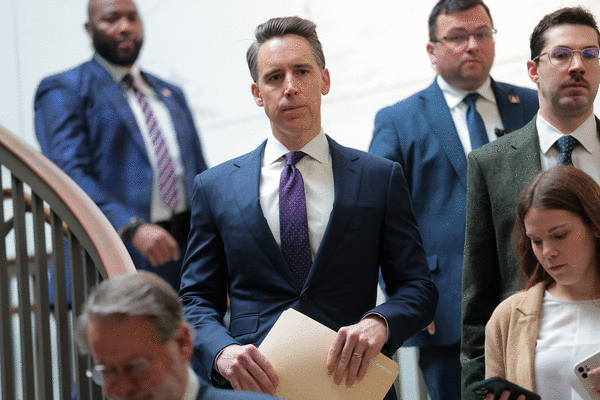
Sen. Josh Hawley, R-Mo., a staunchly anti-abortion conservative, said the Trump administration is going back on its promises by extending the funding for family planning clinics.
‘Natural family planning’
For fiscal 2027 and beyond, the department issued a funding opportunity notice for Title X that gives preference to organizations that emphasize the importance of fertility awareness and “natural family planning,” rather than medical contraception. The guidance encourages applications that provide education and “counseling that encourage lifestyle practices supporting reproductive health and healthy pregnancies.”
The funding proposal does not make clear if abortion providers could apply for and access Title X funds next fiscal year. Asked for comment, Planned Parenthood said it’s too soon to tell what the landscape will look like.
That guidance for 2027 were released much earlier than usual, noted Alina Salganicoff, the senior vice president and director of the women’s health policy program at KFF. The proposals from providers aren’t due until January.
But the release could be a nod to disgruntled anti-abortion Republicans that sets the tone for the future of federal family planning, suggested Clare Coleman, President and CEO of the National Family Planning and Reproductive Health Association.
The administration’s strategy for Title X is best exemplified by that guidance, not the White House’s fiscal 2027 budget proposal, Coleman said. Her organization, which represents clinics that receive federal family planning dollars, anticipates it will spend the next several months lobbying lawmakers not to cut funds, while preparing for changes.
Ultimately, changes to Title X likely will occur through HHS rulemaking, not legislating, she said.
“I think there’s an ideological, programmatic intent for federal family planning that is separate from appropriations,” Coleman said.
Some conservatives like the new direction.
“A Title X program that recognizes natural family planning and fertility awareness instead of pushing contraception would be a step in the right direction,” Lila Rose, president of the anti-abortion group Live Action, said on X.
Reinstating ‘gag rule’
Republicans don’t have the votes on Capitol Hill to eliminate the Title X program — Congress ignored such a request last year, and could do so again
In the interim, anti-abortion groups and lawmakers are pushing the Trump administration to reinstate its first-term rule banning Title X funds from organizations that provide, promote or refer for abortions. The rule required a strict physical and financial separation between Title X-funded entities and any facility having to do with abortion.
The Trump administration initially implemented this so-called gag rule in 2019, but was rescinded by the Biden White House in 2021.
During his confirmation hearing HHS Secretary Robert F. Kennedy Jr. told lawmakers he would reinstate it, but the administration has yet to act despite the increased pressure from conservative groups.
“The Trump-Vance administration must immediately correct course by at a bare minimum reinstating the Protect Life Rule,” SBA said in an emailed statement, adding that not doing so “spells disaster for November.”
HHS signaled its intent to issue a notice of proposed rulemaking in the spring of 2025 described as ensuring Title X “complies with statutorily mandated program integrity requirements,” which could refer to the gag rule. An HHS spokesperson declined to provide further details.
©2026 CQ-Roll Call, Inc., All Rights Reserved. Visit cqrollcall.com. Distributed by Tribune Content Agency, LLC.






Comments