With Artemis II complete, NASA rolls back mobile launcher for Artemis III
Published in News & Features
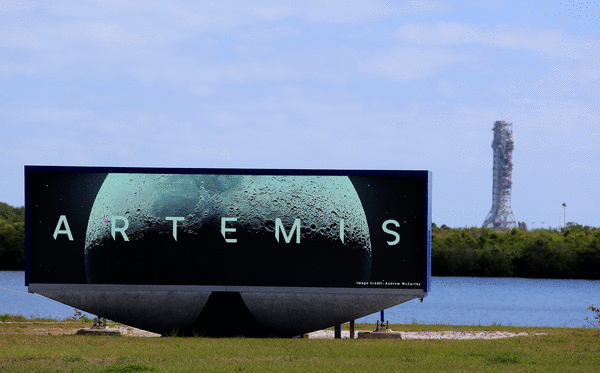
CAPE CANAVERAL, Fla. — It’s job done with Artemis II, as the mobile launcher 1 tower that has sat on Kennedy Space Center’s Launch Pad 39-B since the historic moon mission took flight was picked up for a ride back to the garage Thursday to get ready for next year’s Artemis III.
The crawler-transporter 2, which has been hauling NASA’s spacecraft since Apollo, crept up to the ML1 and began the roughly 4-mile journey to haul the more than 11 million pound tower to the Vehicle Assembly Building at 8:11 a.m. The tower is not expected to enter the VAB until Friday.
It endured some damage from the launch of the Space Launch System rocket and its 8.8 million pounds of thrust, but not as much as it did during the first Artemis launch in 2022, according to NASA officials.
“The mobile launcher is in good condition overall,” said Lakiesha Hawkins, acting deputy associate administrator for NASA’s Exploration Systems Development Mission Directorate. “While we need to fix a few things, having the mobile launcher in good condition really ensures that we’ll be ready to start stacking the Artemis III vehicle according to the timeline that supports launching that mission next year.”
At the VAB, the launch tower will need repairs to the flame hole panels, elevators, pneumatic panels and umbilical gas lines that were damaged during launch. Other parts of the tower were made more robust after the damage sustained after Artemis I.
With those preemptive efforts panning out, NASA Administrator Jared Isaacman said he expected the teams at Kennedy’s Exploration Ground Systems to be ahead of the game getting ML1 ready to take on the solid rocket boosters and core stage of the Space Launch System rocket needed for that mission, currently on NASA’s manifest for mid 2027.
“This would cut down on the turnaround time that we observed from Artemis I measured in months right now, several months,” he said while Artemis II was still in space. “We can undertake again, world-changing missions like Artemis II right now, and get ready for the next ones at the same time.”
The base section of the SLS rocket’s core stage with the engines is already at the VAB. The rest of it set to leave NASA’s Michoud Assembly Facility in New Orleans on Monday. Meanwhile, the Orion spacecraft is already back on the Space Coast.
Mobile launcher 2, which NASA halted work on recently, also saw some action as cranes removed its crew access arm. NASA officials confirmed that the removal was in part due to making the tower safe ahead of hurricane season, which begins June 1, but also part of the agency’s plan to remove and reuse umbilical arms for spares for ML1. The ML2 became extraneous as it had been part of plans to support a larger version of the SLS that is no longer being pursued.
As far as the hardware that will be used on the next mission, Artemis II flight director Rick Henfling said Orion performed exceptionally and is optimistic that it will be ready to fly as needed.
“The things that we’re going to have to improve upon for Artemis III are relatively small and incremental in nature, as opposed to wholesale redesigns of spacecraft subsystems,” he said. “So overall, I’m extremely pleased with the performance of the spacecraft and how it served as a campsite for our four crew members.”
NASA’s Orion program manager Howard Hu said the big difference will be adding a docking port, since the spacecraft’s goal on Artemis III will be to dock with one or both of the lunar landers in development by SpaceX and Blue Origin.
“Our docking system is ready to go. It’s already been qualified. We’ve already got the flight unit at Kennedy Space Center,” he said. “Later this summer, we’ll integrate it on top of the crew module, and we’ve done a lot of testing already.”
He said that aspect shouldn’t slow the two commercial landers either.
“We expect Blue Origin and SpaceX to work with us on and accomplish that mission,” he said.
NASA’s recent revamp of the Artemis program shifted Artemis III to instead fly with crew close to Earth for the docking demonstration. That would then set up Artemis IV as soon as early 2028, which looks to return humans to the lunar surface for the first time since Apollo 17 in 1972.
That means the SLS rockets will be flying at least once a year, as opposed to the 3 1/2 years seen between Artemis I and II.
After the successful landing of Artemis II last Friday, NASA Associate Administrator Amit Kshatriya said increasing flight rate increases reliability and safety.
“We were waiting to fly this mission for several years,” he said. “A lot of that was because of the issues we saw during Artemis I and making sure we did that the right way. And we tried to make sure the machine was perfect before we flew it.”
But with each launch and faster turnarounds, he said NASA will become more successful.
“We need that muscle memory to exist. We need the data to keep coming in, and we need to be able to quickly iterate and change the machine as we learn from it,” he said. “Everything we learned from Artemis II we’re gonna get right after it, but I would say it’s essential.”
_____
©2026 Orlando Sentinel. Visit at orlandosentinel.com. Distributed by Tribune Content Agency, LLC.






Comments