Review: In 'Becky Shaw' on Broadway, the truth can be such a drag
Published in Entertainment News
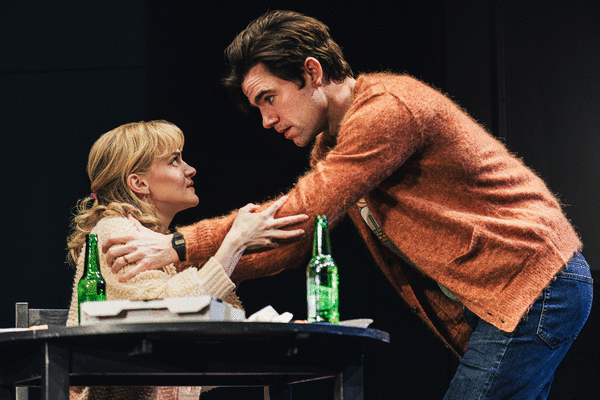
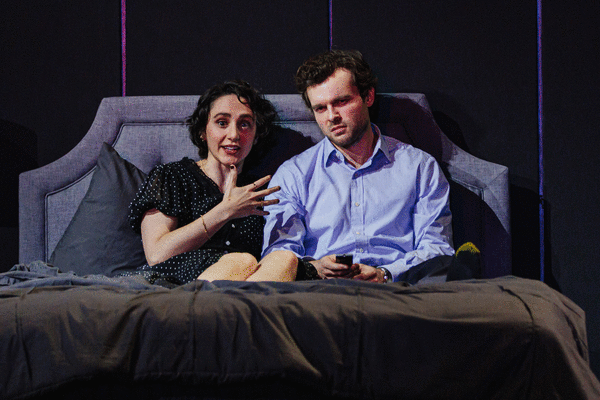

NEW YORK — There are two kinds of Gen-X men in Gina Gionfriddo’s visceral black comedy, “Becky Shaw.”
One type feeds on a woman’s vulnerabilities like an emotional vulture, co-opting the language of intimacy and promising he will “see her” and care for her, all the while needing to keep her in simmering crisis to maintain his own power.
The other kind tells the harsh truth to arm her against life’s inevitable horrors.
Guess which kind Gionfriddo is arguing is the better option?
When she first wrote “Becky Shaw,” a worthy finalist for the Pulitzer Prize in 2009 and a play produced twice before in Chicago, millennials were still babies and the emotional detritus of COVID lockdowns was still far in the future.
So was the ascension of feelings over facts.
But this keenly observed and highly entertaining play, now on Broadway at 2nd Stage’s Helen Hayes Theatre under the unpretentious but lively direction of Trip Cullman, seems to have been lying in wait for this particular moment when we’re finally waking up to the consequences of a society that somehow decided every deeply felt emotion was worth both focus and validation. Even at the expense of the actual truth. And the need to take responsibility.
The woman whose name forms the title here is neither the protagonist nor the authorial voice. That voice would be a character named Suzanna (Lauren Patten) who has two men in her life. One is Max (Alden Ehrenreich), a kind of semi half-brother, having been adopted by her mother and late father after his own parents died and raised as their son. He’s Suzanna’s fraternal soulmate, but also her biggest challenge.
The other is Andrew (Patrick Ball), the man she marries but who she comes to realize is attracted to needy women like a malevolent moth to a flickering flame.
We soon see that Suzanna has had a tough go of life, thanks to a caustic mother (Linda Emond) who stomps on Suzanna’s memories of her dad by taking up with another man, and who rides all over her daughter’s understandable fragility with her withering boomer wit.
Becky Shaw (Madeline Brewer) enters the play as a blind date that Andrew has set up for the perennial single and emotionally unavailable Max, but she’s pretty much a basket case and thus of more interest to the former than the latter. She’s also a catalyst for a play’s central battle for Suzanna’s soul.
Ehrenreich has been gifted one heck of a role here, a character that basically spits out the truths that everyone else, including the audience, is scared to say. “You need to be a big girl and face your big girl problems,” he says to Suzanna at the top of the play, telling her, “I don’t like this weepy-weepy wah-wah thing you’re doing,” jolting her from her bedroom wallowing with trash television.
When she says her mother insulted her father’s memory by showing up with her new man to a meeting about her father’s estate, he responds with, “Your father’s dead. His feelings don’t matter.”
Ehrenreich’s character has lots of other seemingly callous lines in this play like that. Their impact first is to shock the audience and then, moments later, you find yourself sitting around people who are realizing that everything this tough-love character is saying is true. That’s in contrast with Andrew’s lexicon of touchy-feely claptrap, all seemingly declarations of support and empathy but, ultimately, hollow.
It’s a measure of the quality of Ehrenreich’s superb performance in what is generally an admirably straightforward production that he never tries to make his character more likable than Gionfriddo writes him, yet he lays all these bon mots with a palpable vulnerability. He understands that Max is operating on two tracks at once, spitting out the tough lessons partly as his philosophy of life but also as a way of avoiding the intensity of his own feelings. Gionfriddo intends him to grow on the audience as the play progresses, and so he does.
Ehrenreich has come up with by far the most complex of the five performances here, but they’re all well-toned, with Ball being especially cleverly cast, likely confounding fans of his from HBO’s “The Pitt” by playing what seems to be an opposite character, although maybe not, it turns out.
Emond is terrific as the caustic mother of all tough-love mothers, Brewer is just creepy enough in the title role and Patten’s performance as Suzanna feels indelibly authentic in an admirably unflashy way, as if the actress can see that what the play is weighing here is how a woman who collides (as we all eventually do) with some of life’s inevitable challenges of love and loss can best get back in the ring and fight another day. For what choice do we have, dear reader?
I don’t mean to imply “Becky Shaw” is some kind of broadside against getting all stuck up in your sadnesses and it certainly does not argue that women need to be saved by their lovers. It’s just noting that they can either help or hurt.
But this nuanced and funny American play — underrated until now — does illuminate the corrosive power of very needy people and their ability to take down others to fill their own voids. It struck me as an interesting choice for a first date in that it should spark immediate conversation as to whether either party wants a second one.
———
At the Hayes Theater, 240 W. 44th St., New York; 2st.com.
———
©2026 Chicago Tribune. Visit chicagotribune.com. Distributed by Tribune Content Agency, LLC.









Comments