Review: In devastating new Broadway 'Death of a Salesman,' decades of work show in Nathan Lane's face
Published in Entertainment News
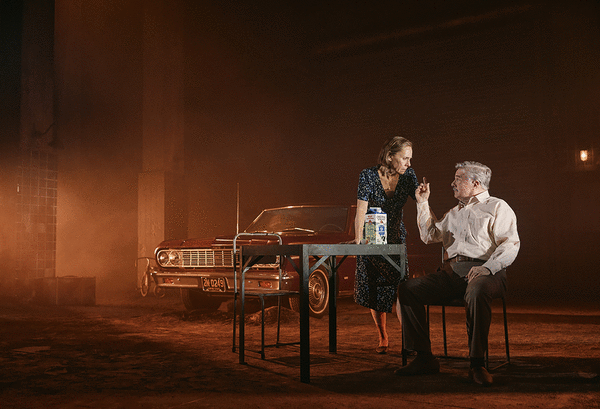
NEW YORK — Arthur Miller’s “Death of a Salesman,” now back on Broadway in a haunting new production at the Winter Garden starring Nathan Lane and Laurie Metcalf, is one of the saddest American plays ever written. Its most melancholy scene of all involves Willy Loman, a traveling salesman who has given his unnamed company the best years of his now weary life, walking into the head office only to be humiliated by the callow young man who now runs his company and could not give a damn for him.
Miller wrote the play long before the rise of artificial intelligence sent shivers through the American workforce.
But in the scene where Willy asks for a job in town, not schlepping every week to New England, all the fears of the older worker are manifest. There is the new technology Willy doesn’t understand, the disloyalty of his mercenary company that makes him feel betrayed, the humbling that leads him to lash out, making everything so much worse. If there’s an American workplace nightmare, it’s in this scene. Written in 1949!
And as played by Nathan Lane and John Drea in Joe Mantello’s exquisitely directed Broadway revival, which has several Steppenwolf Theatre influences, it will sock you in the gut.
Sure did me. And I’ve seen this play countless times. Then again, when you get close to Willy’s age, you also start to see this play differently. Very, very differently.
“Death of a Salesman” is familiar Broadway territory, but the play allows for many different entry points and Willy has not always seemed so sympathetic as Lane makes him here.
Philip Seymour Hoffman played him on Broadway as a near-psychotic, his philandering very much to blame for the fall of his elder son, Biff. Brian Dennehy embodied him at the Goodman Theatre as a kind of fallen giant, a weary, Woyzeck-like figure worn down on the turntable of life. One watched him with fear in director Robert Falls’ production.
Lane, though, not only captures Willy’s ordinariness and his ubiquity, which is no small achievement for so famous an actor, but also his optimism, his foundational, near-Trumpian belief in a coming Very Big Deal for either him or his sons. His delusion is central to why this revival is so potent.
Miller was arguing in this play that Willy had tragic magnitude because Brooklyn, and all the other Brooklyns across America, contained tens of thousands of him, weary postwar foot soldiers of American business who were never going to be leaders of men but to whom, in his wife Linda’s words, “attention must be paid.”
Mantello’s production actually frees the play from its own time, expanding its vista. The big visual element in Chloe Lamford’s deceptively simple set is a Chevy from the mid-1960s. Willy drives it onstage through a giant door at the start and ends his life therein. Aside from that, the staging is generally more skeletal. Actors who are not in a scene wait in the wings. The props are akin to what you could find in a rehearsal studio. To a point.
That leads you at times to think that Mantello has imagined the play, with its famous flashbacks as Willy imagines the road not taken, as taking place inside Willy’s head.
Miller, of course, structured the play differently, as snapping back between realism and symbolism, as manifest in Jo Mielziner’s famous original set. But Mantello has stripped much of that away, leaving you with Lane and Metcalf playing hard-working Americans, twisting in the harsh winds of capitalism as they become progressively more dispensable.
For those who know the play well, some of Mantello’s choices are most striking, especially the horror here of the famous hotel-room scene with a tawdry lover (brutally played by Katherine Romans), an act born of loneliness that destroys a father’s relationship with his son forever.
There but for the grace of God … any parent thinks.
Mantello has chosen to have different actors play the young Biff (Joaquin Consuelos) and the young Happy (Jake Termine), sharpening the contrast between their potential and their fates. And, in the famous final scene, he has Willy’s only true friend, Charley (K. Todd Freeman) deliver not the usual monologue but a prepared eulogy at perhaps the saddest funeral you will ever have seen on a stage. Who will be at mine, you ask.
Throughout all of this, you are listening here to a beautiful original score, composed by Caroline Shaw as an elegy for a life, unremarkable but of worth.
Steppenwolf ensemble member Metcalf, unsurprisingly, is wholly unsentimental. She does not play Linda as an enabler but as a tragic figure in her own right. Just one shorn of scenes and words. She really doesn’t need them to say what she needs to say.
Christopher Abbott, who plays the elder Biff, comes freighted with a sense of his own doom, even as he fights for his future. And Ben Ahlers, who plays Happy, comes of course with that actor’s famously warm smile and chirpy demeanor, slowly worn down here before your eyes, as the permissible frolics of youth turn into the stasis of one going nowhere.
Lane was gifted with that kind of face and personality, too, of course, replete with diagonal eyebrows that join his cheekbones in a quizzical demeanor that throughout his career has signaled the joys of life. He made his bones in musicals, playing characters who bounce back from whatever happens.
Here, no bounce is forthcoming, beyond that of a dad cat, anyway. Willy’s world is not one of musicals but of actual, soul-crushing work, and it wears him out. That Lane can so clearly reveal that to us is as remarkable as it is devastating.
———
At the Winter Garden Theatre, 1634 Broadway, New York; salesmanbroadway.com.
———
©2026 Chicago Tribune. Visit chicagotribune.com. Distributed by Tribune Content Agency, LLC.










Comments