House panel advances bill on temporary US attorneys
Published in Political News
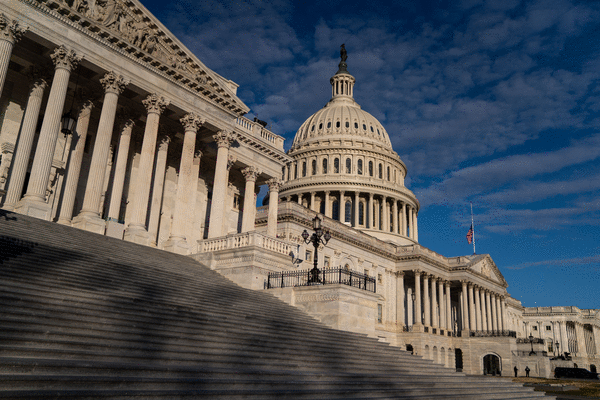
WASHINGTON — A sharply divided House Judiciary Committee advanced a bill Thursday that would greatly expand an administration’s ability to install hand-picked officials for top prosecutor roles.
The panel, in a 12-11 party-line vote, approved legislation that would strip district court judges of their power to appoint temporary U.S. attorneys in certain circumstances, as some courts have sought to do during the second Trump administration.
Under current federal law about vacancies, the attorney general is allowed to select an interim U.S. attorney to serve for 120 days, after which the appointment authority falls to the district court. The bill would remove the section that gives the authority to the court and change language in another section that sets out the 120-day limit.
The Trump administration, in districts across the country, has sought in the past year to bypass the Senate confirmation process to install its picks and extend their tenures. Some district courts have sought to exert their authority to pick interim U.S. attorneys.
A string of temporary U.S. attorneys has attracted national attention in some districts, as the Trump administration has sought to wield the power of the Justice Department to target its enemies with prosecutions and criminal investigations.
The legislation, if passed by the House, faces little chance of passing in the Senate as a stand-alone bill.
Rep. Derek Schmidt, a Kansas Republican and sponsor of the bill, said senators are abusing a Senate Judiciary Committee tradition that gives home-state senators a de facto veto over U.S. attorney nominees for their home states, something known as the “blue slip” process.
The Democratic senators, Schmidt said, were misusing the tradition to stonewall U.S. attorney nominees, leaving vital law enforcement positions to go without permanent leadership.
Schmidt said the bill would put an “end to the delay tactics and gamesmanship by senators to prevent the executive branch from exercising its constitutional responsibility to steer the U.S. attorneys’ offices.”
The bill would also end attempts by district courts to install their own picks, Schmidt said, something he said violates the Constitution and usurps the authority of the executive branch.
Democrats repeatedly panned those arguments in committee. They contended that under the bill, the executive branch could simply abandon the Senate confirmation process for U.S. attorneys by cycling through its interim choices continuously.
Rep. Dan Goldman, D-N.Y., said the Advice and Consent clause would be written out of the Constitution under the bill, and a president would never go to the Senate to seek confirmation of his U.S. attorneys.
“Rather than try to eliminate the Advice and Consent clause, why don’t you encourage the president to find someone that both parties can agree on,” Goldman said.
The bill would delete language passed by Congress in 2007 amid a George W. Bush-era controversy over the firing and appointment of U.S. attorneys, in which then-Sen. Dianne Feinstein and a group of other senators advocated on the chamber floor for restoring a 120-day cap on the executive branch’s interim appointment power.
The wording of that legislation was also at the center of the high-profile criminal cases against former FBI Director James B. Comey and New York Attorney General Letitia James, prosecutions widely seen as part of a retribution campaign from Trump against perceived political adversaries. Those arguments related to the appointment of a temporary U.S. attorney who brought the cases.
The defense teams argued that law limits the Justice Department’s interim appointment power to 120 days total. But the Justice Department contended the wording allows for an attorney general to make multiple interim appointments and that a new 120-day clock starts for each one.
_____
©2026 CQ-Roll Call, Inc. Visit at rollcall.com. Distributed by Tribune Content Agency, LLC.


















































Comments