Venezuelan opposition leader testifies that ex-Congressman Rivera did not help his cause to oust Maduro
Published in Political News
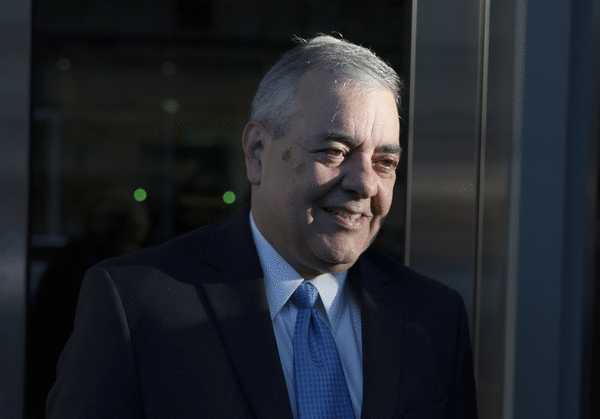
MIAMI — For several years, former Miami-Dade Congressman David Rivera has maintained that he helped funnel money from his $50 million contract representing the U.S. subsidiary of Venezuela’s national oil company to politicians opposing socialist President Nicolás Maduro.
Some of that money, Rivera has said, went directly to the jailed opposition party leader, Leopoldo Lopez, who was released by the Maduro regime in 2017 during a time of political upheaval in Venezuela and threatened economic sanctions by the U.S. government.
But this week, an exiled leader of a Venezuelan opposition party testified at Rivera’s federal trial in Miami — where he’s charged with failing to register as a foreign agent for Venezuela — that the former Republican congressman met with him in 2017 to help the opposition’s cause to oust Maduro but did not deliver on his promise.
Julio Borges, the former president of the Venezuelan National Assembly, testified he was unaware of Rivera’s 2017 consulting contract with the American subsidiary of PDVSA and of any financial support Rivera or his associates may have provided to the political opposition in Venezuela.
Borges testified that he met with Rivera, Texas Republican Congressman Pete Sessions and wealthy Venezuelan businessman Raúl Gorríin for about one hour in New York on April 2, 2017, to discuss anti-Maduro efforts — but aside from that gathering, he said, Rivera was of little help to him.
Borges, who founded the Primero Justicia party, said his primary goal was to gain access to then-President Donald Trump through Vice President Mike Pence, Secretary of State Rex Tillerson and House Speaker Paul Ryan. His secondary goal was to push for sanctions against Maduro and other high-ranking political and military officials in Venezuela after the president had canceled the opposition’s victorious election results in the National Assembly.
Asked by prosecutor Roger Cruz whether Rivera helped him with his goals, Borges testified: “No, never.”
Then Cruz asked him if Rivera made any promises in the meeting and WhatsApp communications to introduce Borges to other U.S. officials.
“Mr. Rivera sold himself (as someone who) could give you access to many people in the United States, but he never did anything for me,” Borges testified before the 12-person federal jury.
Among Rivera’s contacts was his friend, then-Florida GOP Sen. Marco Rubio, who testified Tuesday at the Miami trial. But Borges said he had known Rubio, a staunch anti-Maduro politician, for several years, and could contact him on his own without Rivera’s assistance.
Borges, who was forced to leave Venezuela and move to Spain because of threats to his life, testified on Friday that he did not remember Rivera’s co-defendant, Esther Nuhfer, attending the April 2, 2017, meeting with Rivera, Sessions and Gorrín. Borges said he only knew of Nuhfer, a political consultant, from media reports.
Despite Borges’ testimony as a government witness over the past three days, the indictment charging Rivera and Nuhfer with conspiring against the United States and failing to register as foreign agents for Venezuela alleges that Nuhfer also attended the New York meeting on that April day.
Separately, the indictment says, Rivera also met that same day in New York with Sessions and Venezuelan Foreign Minister Delcy Rodríguez, who wielded tremendous influence over Venezuela’s oil industry. Rodríguez would go on to replace Maduro as president in January of this year after U.S. forces seized Maduro and brought him to the United States to face drug-trafficking charges.
At the start of the trial on Monday, prosecutors portrayed Rivera and Nuhfer as “secret” foreign agents for Venezuela who were driven by “greed” when Rivera’s company signed a $50 million lobbying contract to “normalize” relations with Maduro.
In opening statements, Cruz said the two defendants deliberately did not register as agents for Venezuela so they could lobby Rubio, Sessions and other government officials without them knowing the pair was doing the bidding of Maduro’s government under the $50 million contract with the U.S. subsidary of Venezuela’s nation oil company, PDV USA. Rivera’s company, Interamerican Consulting, signed the contract in March 2017.
Cruz said the defendants may claim they were trying to promote the interests of PDV USA, which operates as the Houston-based oil company CITGO, and rekindle business dealings between Exxon and Venezuela — but they were really using their political access to prevent U.S. sanctions against Maduro and his government.
“They orchestrated a secret influence campaign for $50 million,” Cruz told the jury, adding they “spoke in code (in online chats) because they didn’t want anyone to know what they were doing.”
But defense attorneys said Rivera and Nuhfer, known as anti-communist and anti-socialist advocates for decades, would never help Maduro and his government, arguing they were trying to remove him from power and replace him with an opposition leader through democratic elections. While those goals were never fulfilled, the Trump administration, pushed by Rubio, imposed sanctions against Maduro and 13 other high-ranking Venezuelan officials in 2017.
They said the pair dealt directly with the American subsidiary of Venezuela’s state-owned oil company and were not required to register under the Foreign Agents Registration Act, which promotes transparency by lobbyists working on political issues for foreign countries.
“The whole theory of the government’s case is utterly preposterous,” Rivera’s attorney, Edward Shohat, told the jury. “At no time ... not just in 2017 and 2018 ... has David Rivera said one thing to help Nicolás Maduro normalize relations with the United States.”
Nuhfer’s lawyer, Margot Moss, pointed out that it was Rivera’s consulting company that signed the $50 million contract with the U.S. subsidiary of Venezuela’s national oil company. Moss said Nuhfer introduced Rivera to a Miami developer, Hugo Perera, who put him in touch with the wealthy Venezuelan TV mogul, Gorrín, known to be close to Maduro and other top officials.
“What Esther was doing did not require her to register” as a foreign agent for Venezuela,” Moss told the jury. “Frankly, she was doing next to nothing. She just wanted to get a referral fee. ... You’re not going to see any evidence of Esther as a foreign agent.”
But according to an indictment, Rivera, Nuhfer and others joined forces to lobby Rubio, then the Republican U.S. senator from Miami, and lawyer Kellyanne Conway, a White House adviser during Trump’s first term in office.
Rivera and Nuhfer were unable to meet with Conway, but they did arrange two meetings with Rubio and others in Washington in July 2017, when they discussed a plan to persuade Maduro to hold democratic elections and step down as president.
Maduro meeting
According to the indictment, Rivera also collaborated with Gorrín to arrange a meeting between Sessions, the Texas Republican congressman, and Maduro in Caracas.
On April 2, 2018, the indictment says, Rivera, Gorrín and Sessions met with Maduro and other Venezuelan politicians to discuss normalizing relations between the United States and Venezuela. As part of the meeting, Sessions agreed to carry a letter with that proposal from Maduro to then-President Trump, who was serving in his first term, but their efforts were unsuccessful.
In the end, Rivera’s consulting firm received $20 million from PDV USA before the U.S. subsidiary ended the contract after a falling out in 2017.
Court documents in both the criminal case and a parallel civil lawsuit revealed that Rivera diverted more than half of his PDV USA income — $13 million — to three subcontractors in Miami who supposedly provided “international strategic consulting services” for the U.S. subsidiary of Venezuela’s national oil company. The three recipients of the proceeds were Gorrín, Nuhfer and Perera.
Perera “is the star witness” for the government because he was an insider with access to Gorrín, Nuhfer’s attorney, David O. Markus, said at a court hearing last week. Markus noted that Perera received about $5 million from Rivera for making introductions but was not charged with him and Nuhfer.
Perera, who has a criminal history as a convicted drug trafficker, is expected to testify as a cooperating witness for the government.
_____
©2026 Miami Herald. Visit miamiherald.com. Distributed by Tribune Content Agency, LLC.



Comments