Budget resolution for immigration funds expected next week
Published in Political News
WASHINGTON — Senate Republicans plan to release a budget resolution next week that would kick-start the process for a reconciliation bill on immigration enforcement funding and help end a partial shutdown of the Department of Homeland Security, lawmakers said Thursday.
The party is aiming to provide about $70 billion in funding for Immigration and Customs Enforcement and the Border Patrol to sustain them for at least the next three years, without placing any new guardrails on federal immigration agents sought by Democrats. The budget resolution would contain instructions to the Homeland Security and Governmental Affairs and Judiciary panels, which would be charged with writing the details of the upcoming reconciliation bill.
Senate Majority Leader John Thune, R-S.D., said Thursday that the chamber is “hoping to get on a budget resolution by middle to end of next week.”
“It’s drafted,” Thune said. “Text hasn’t been released, but we’ve been working on it for some time.”
Thune said Republicans have had “a number of conversations” with Senate Parliamentarian Elizabeth MacDonough, who provides guidance about what is allowed in reconciliation under Senate rules.
Speaker Mike Johnson, R-La., has said he would hold up a Senate-passed bill that funds the department except for immigration enforcement functions until a budget reconciliation bill providing funding to those agencies is passed.
The administration has set a June 1 deadline for that bill, which could mean another month and a half of the shutdown.
Some Republicans in both chambers, especially the House, have been calling for the party to take this opportunity to pursue a wider reconciliation package that could encompass everything from farm aid to defense and voter ID measures.
But the Senate is hesitant to expand the package, especially with the shutdown continuing. Sen. John Hoeven, R-N.D., said the Senate is responding to the House’s request for immigration enforcement funding to clear a path for the Senate’s DHS appropriations bill.
“Every time you add stuff to it, you add committees of jurisdiction, you add complexity, and you add more time, right?” he said. “So if they want it expeditiously, which is what we’re working on right now, then you wouldn’t add stuff, right?”
Top DHS officials, meanwhile, took to Capitol Hill Thursday to bemoan the shutdown and highlight its negative repercussions.
Beyond the thousands of personnel who have gone without pay, the shutdown has had major effects on Customs and Border Protection’s operations, Rodney Scott, the agency’s commissioner, said during a House Homeland Security Appropriations Subcommittee hearing.
Scott said the agency has been unable to pay service providers and confidential human sources during the shutdown.
“That means aircraft, patrol boats, and patrol vehicles that need service are being parked,” he said. “Border surveillance equipment that requires maintenance is offline until funding is appropriated.”
Customs and Border Protection workers that were set to receive advanced training ahead of this summer’s FIFA World Cup have not received that training, and small businesses that serve as contractors may have to lay off employees “because we can’t pay them.”
“The problems will compound until this body takes action and funds DHS,” Scott said.
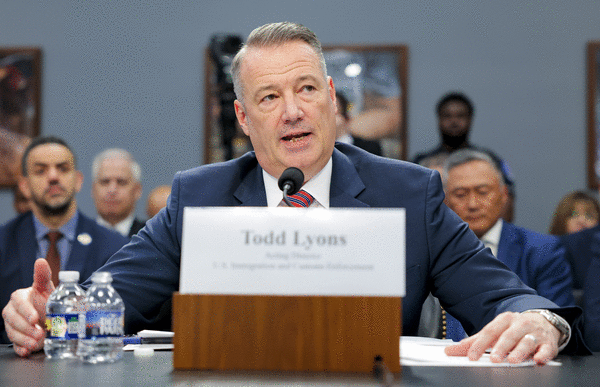
Immigration and Customs Enforcement has been able to use funding from last year’s budget reconciliation law to offset the effects of the shutdown to some degree. In his written testimony, Todd Lyons, who is performing the duties of the director of ICE, said that the agency has obligated $11 billion of the $75 billion it received in that law as of March 19.
But the agency can’t use the reconciliation funding to pay non-law enforcement personnel, operate”basic services” within ICE, or conduct criminal investigations into human trafficking and child exploitation, he said.
Trump moved earlier this month to pay non-law enforcement personnel through pre-existing funds, though that has not solved all the problems that the shutdown has posed.
A flexible $10 billion “border support” fund appropriated in last year’s reconciliation law was down to $4.2 billion as of April 6, according to the White House budget office, as that money gets drained to pay other agency expenses, including law enforcement salaries.
At a separate afternoon hearing, Coast Guard Commandant Adm. Kevin Lunday thanked Trump for taking that action, which includes paying thousands of Coast Guard civilian employees.
But Lunday said the shutdown is hurting personnel, operations and “hollowing out” readiness. For example, the Coast Guard has more than 5,000 unpaid utility bills at their facilities, and a massive backlog of merchant mariner credentials.
The Transportation Security Administration’s efforts to deploy technology to airports and mitigate drone threats has suffered, acting TSA administrator Ha Nguyen McNeil said. “Every day the shutdown drags on, the long-term implications to our security posture intensify,” she said.
The Federal Emergency Management Agency has $3.4 billion left in its disaster relief fund, acting FEMA administrator Karen Evans said. The agency temporarily lost access to over $17 billion provided in last year’s funding extension when the shutdown started.
While the agency hasn’t yet officially shifted to “immediate needs funding,” a triage approach to dispensing aid, Evans said the administration is prioritizing life-saving activities because of the shutdown.
The officials also discussed the fiscal 2027 budget requests. Scott, in his written testimony, reported that daily encounters at the southern border have declined by 96%, averaging approximately 250 per day, from more than 5,000 a day during President Joe Biden’s administration.
Customs and Border Protection requested $22.9 billion in discretionary funding for fiscal 2027, which is a cut from the $23.9 billion funding rate the agency was receiving before stopgap funds lapsed in February.
Immigration and Customs Enforcement discretionary funding would stay relatively flat at $10 billion, though the agency does have $64 billion on hand from last summer’s reconciliation law and could receive more in a second bill.
Rep. Lauren Underwood, D-Ill., grilled Lyons about deaths in ICE custody and the agency’s lack of responsiveness to congressional oversight questions.
“Enough is enough,” she said. “This committee cannot keep bankrolling atrocities. Not one more penny.”
(Savannah Behrmann contributed to this report.)
©2026 CQ-Roll Call, Inc., All Rights Reserved. Visit cqrollcall.com. Distributed by Tribune Content Agency, LLC.





















































Comments