After Maduro's fall, Colombia eyes gains in security, trade and border control
Published in News & Features
The political and security shockwaves unleashed by recent events in Venezuela are rapidly reshaping the regional landscape — and for Colombia, they may represent a rare moment of opportunity after years of instability along its eastern border.
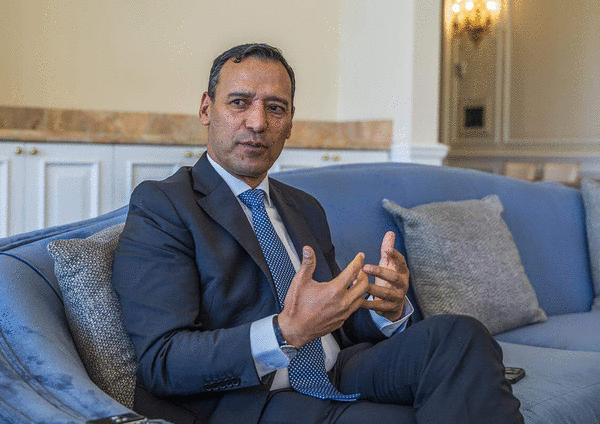
Colombian Defense Minister Pedro Arnulfo Sánchez said on Thursday that the evolving relationship between Washington and Venezuela’s new authorities is creating an opening to strengthen cross-border security cooperation, disrupt drug trafficking routes and revive economic ties long frozen by political tensions.
“This is a significant opportunity,” Sánchez said in an interview with The Miami Herald, pointing to emerging coordination with Venezuela’s newly appointed defense leadership. “We are already working to strengthen joint efforts against drug trafficking and organized crime.”
Sánchez gave the interview in Miami, where he was participating in a hemispheric security forum organized by the Heritage Foundation, gathering policymakers and security experts from across the region to discuss emerging threats and regional cooperation.
For decades, Colombia’s 1,300-mile border with Venezuela has been a humanitarian corridor and a security nightmare — a vast, porous region where guerrilla groups, drug cartels and criminal networks have thrived with limited state control. That dynamic intensified under Nicolás Maduro, when cooperation between the two countries largely collapsed.
Now, following Maduro’s removal and a broader U.S.-backed transition, Bogotá sees a chance to reverse that trend.
The United States, which captured Maduro on Jan. 3 in a pre-dawn military operation in Caracas, has backed Venezuela’s interim government, led by Delcy Rodríguez, and expanded its influence over key sectors, including the oil industry, as part of broader efforts to stabilize the country after years of economic collapse and political crisis. Trump has repeatedly described Rodríguez, who was Maduro’s vice president, as “wonderful” and said she has been “doing a great job.”
Colombian officials have long accused armed groups — including ELN guerrillas, FARC dissidents and the powerful Clan del Golfo — of using Venezuelan territory as a safe haven to regroup, traffic drugs and launch attacks.
The defense minister suggested that could begin to change.
“If we can align efforts with Venezuela, these groups will lose strategic depth,” he said, referring to the cross-border sanctuary that has allowed criminal organizations to operate with relative impunity.
Such cooperation could have immediate operational effect. Colombia currently conducts a combat operation roughly every 20 hours and dismantles a drug trafficking facility every 40 minutes, according to official figures. Eighty percent of drug seizures by the U.S. Coast Guard already stem from Colombian intelligence — a level of coordination that officials say could expand significantly with Venezuelan participation.
Beyond security, Bogotá is also eyeing economic gains.
Improved relations could reopen cross-border trade, boost energy integration and revive tourism in regions battered by years of conflict and neglect. Border departments like Norte de Santander — home to the volatile Catatumbo region — stand to benefit the most.
Catatumbo remains one of Colombia’s most dangerous flashpoints. Just more than a year ago, ELN violence there left more than 200 people dead, displaced 20,000 and confined tens of thousands more. While the situation has somewhat stabilized, the minister warned that armed groups continue to exploit the region’s drug economy.
The government’s response — a mix of military pressure and social investment under the Pacto por el Catatumbo — could gain traction if cross-border criminal flows are curtailed.
“The real solution is replacing illegal economies,” the minister said. “But that becomes much harder if these groups can simply move across the border.”
The opportunity comes as Colombia confronts evolving threats at home.
Among the most pressing is the rapid adoption of drone warfare by criminal groups. Authorities recorded more than 9,000 attempted drone attacks last year, a dramatic shift in the tactics used by cartels and guerrillas.
The government is now investing heavily in a “National Anti-Drone Shield,” a $1.5 billion effort to deploy advanced detection and neutralization systems in coordination with more than 20 countries.
“This is changing the nature of conflict,” the minister said. “We are adapting in real time.”
Officials argue that stronger regional coordination — particularly with Venezuela — will be essential to keeping pace with these technological shifts, as armed groups increasingly operate across borders.
Migration and stability risks remain
Still, the opening comes with significant risks.
Colombia has reinforced its military presence along the border amid fears that instability in Venezuela could trigger a new wave of migration, with some officials warning the influx could reach into the millions.
At the same time, the country faces rising political tensions ahead of presidential elections and persistent violence in rural and urban areas.
The minister acknowledged a complex threat environment that includes not only physical attacks from armed groups, but also cyber operations and disinformation campaigns aimed at destabilizing the political process.
Yet officials insist the current moment — however fragile — offers a strategic inflection point.
For the first time in years, Colombia, the United States and Venezuela may be moving, however cautiously, in the same direction on security.
Whether that alignment holds could determine not only Colombia’s internal stability, but the future balance of power across a region long shaped by conflict, mistrust and missed opportunities.
©2026 Miami Herald. Visit miamiherald.com. Distributed by Tribune Content Agency, LLC.






Comments